.svg)
.svg)
.svg)
.svg)
.svg)
When most people in Los Angeles picture learning piano, they imagine years of stiff lessons, sheet music covered in scary black dots, and a metronome ticking like a tiny judge.
Fair.
But here's the thing nobody tells you at the start: you don't need any of that to play actual songs.
You need piano chords.
Chords are the shortcut. They're how a kid in Westwood plays a recognizable song in week two instead of month ten. They're how the adult who "always wanted to learn" finally sits down and makes something that sounds like music instead of homework.
And once you understand how a piano chords chart works, the whole instrument stops feeling like a math test and starts feeling like a playground.
So let's break it down. All of it. In plain English, from someone who has taught this to hundreds of beginners across LA.
By the end of this guide, you'll know what a chord actually is, how to read a piano chords chart without a music degree, how to build any chord yourself with one simple formula, and which chords to learn first so you're playing real songs fast.
Let's get your hands on the keys.
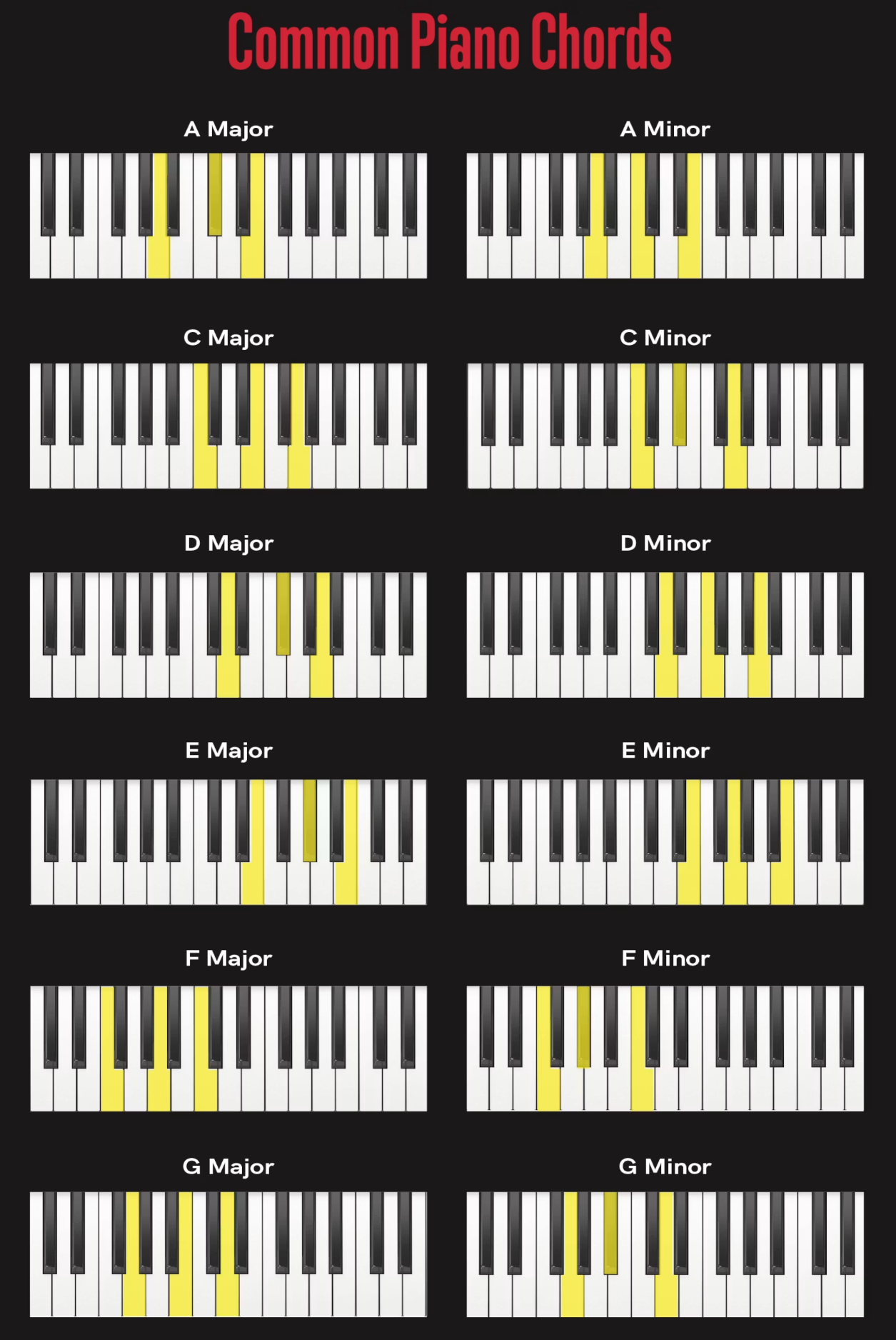
What Is a Piano Chord, Really?
A piano chord is just three or more notes played at the same time.
That's it. That's the whole secret.
One note is a note. Press two or more together in the right combination, and you get a chord. Chords are what give music its mood. They're the difference between a song that feels happy, sad, tense, dreamy, or triumphant.
Think of a single note as one voice. A chord is a group of voices singing together. And when you string chords one after another, you get a chord progression, which is basically the emotional backbone of every song you've ever loved.
Here's why this matters for beginners.
Most people think you learn piano by reading one note at a time, left to right, like slow reading. That works. It's also the reason a lot of people quit.
Chords flip the script. Learn a handful of them, and you can play along with thousands of songs. Pop, worship, jazz, film scores, the stuff your kid hums in the back seat on the 405. All built on chords.
So before we touch a single chart, sit with this one idea:
Chords are the fastest path from "I'm trying piano" to "I play piano."
Now let's learn how to read them.
Half Steps and Whole Steps (start here)
Before any chord makes sense, you need one idea: the half step.
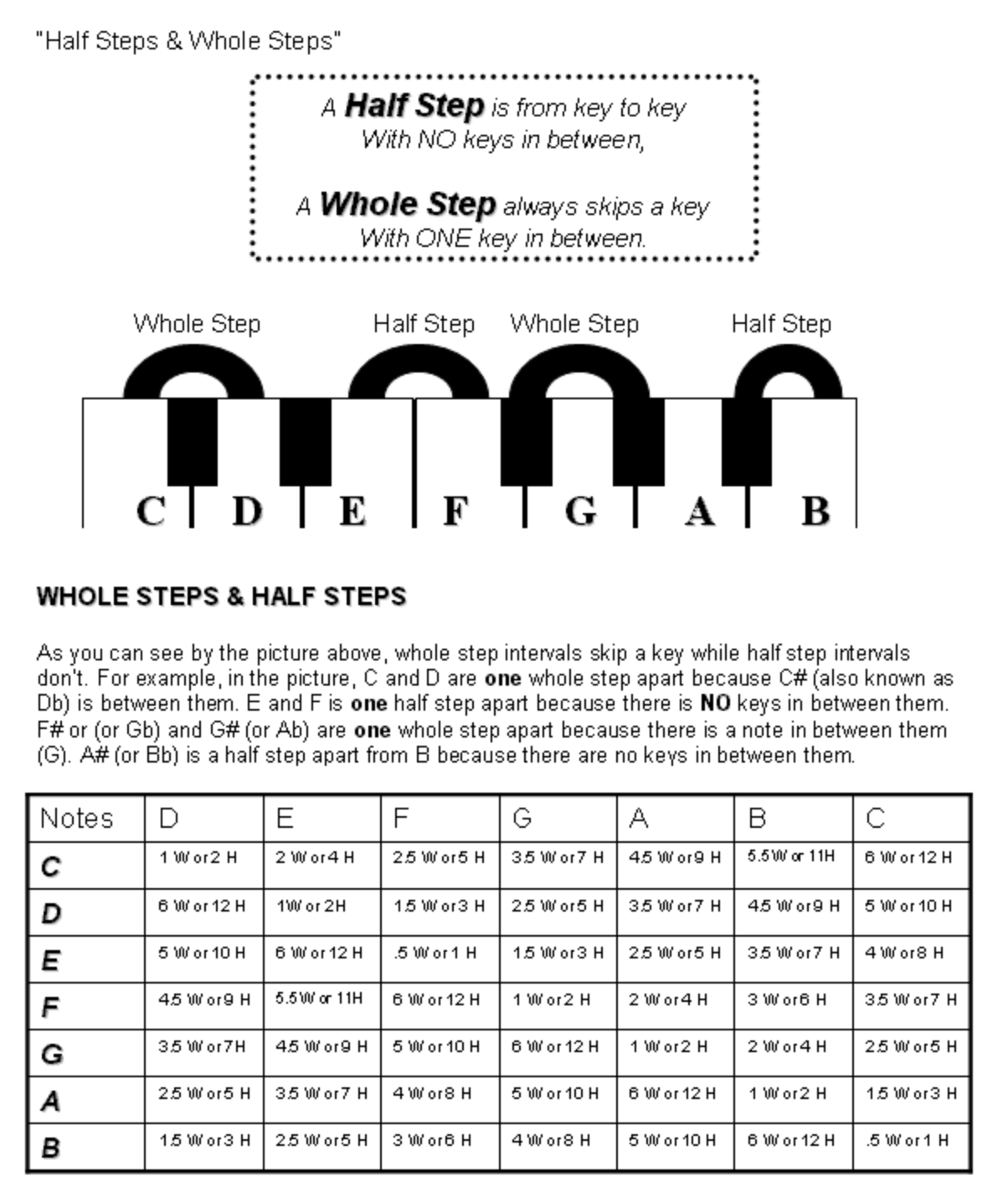
A half step is the distance from one key to the very next key, with nothing in between. That includes black keys.
- C to C# is a half step.
- E to F is a half step too (look at your keyboard; there's no black key between them).
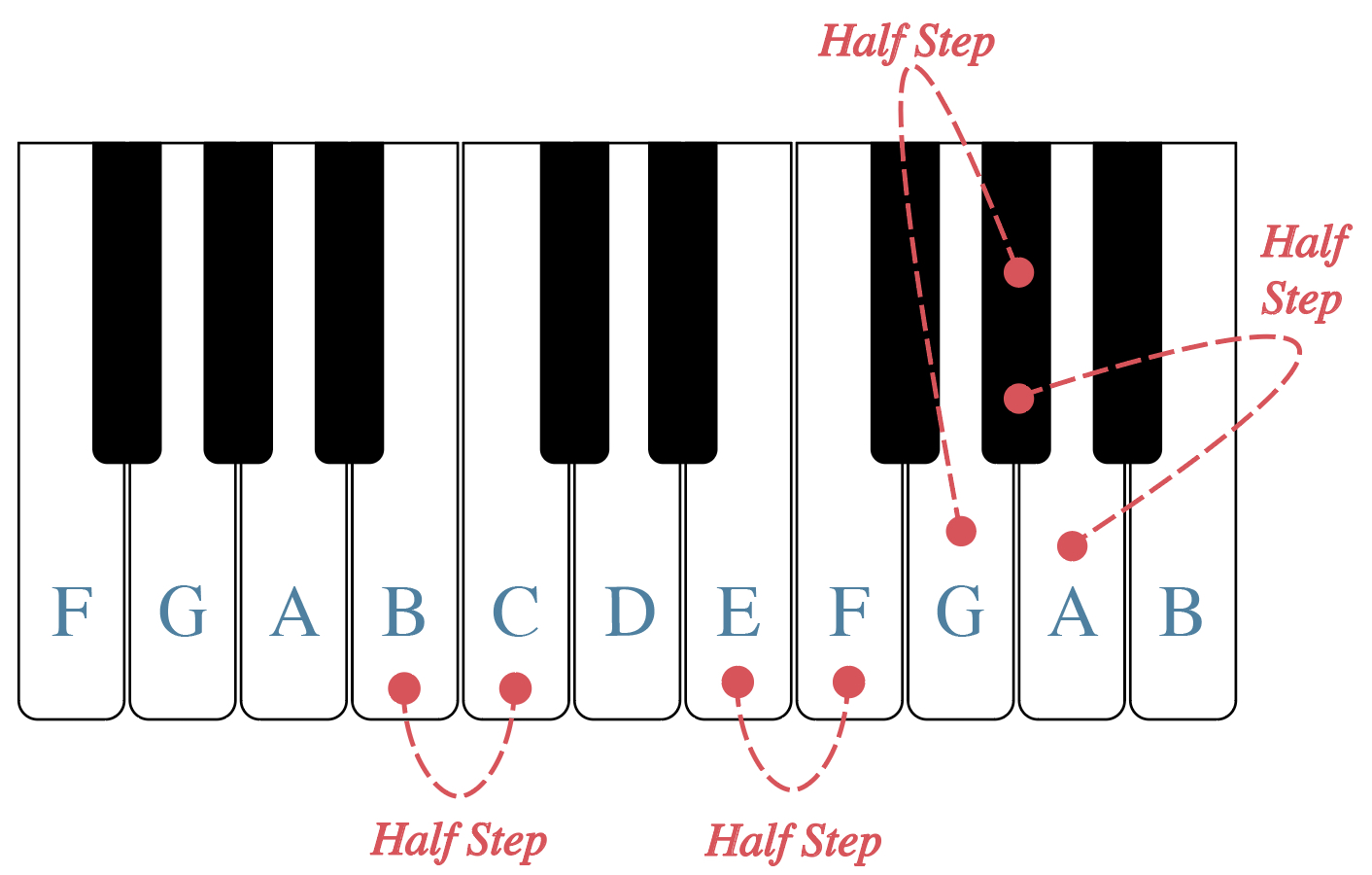
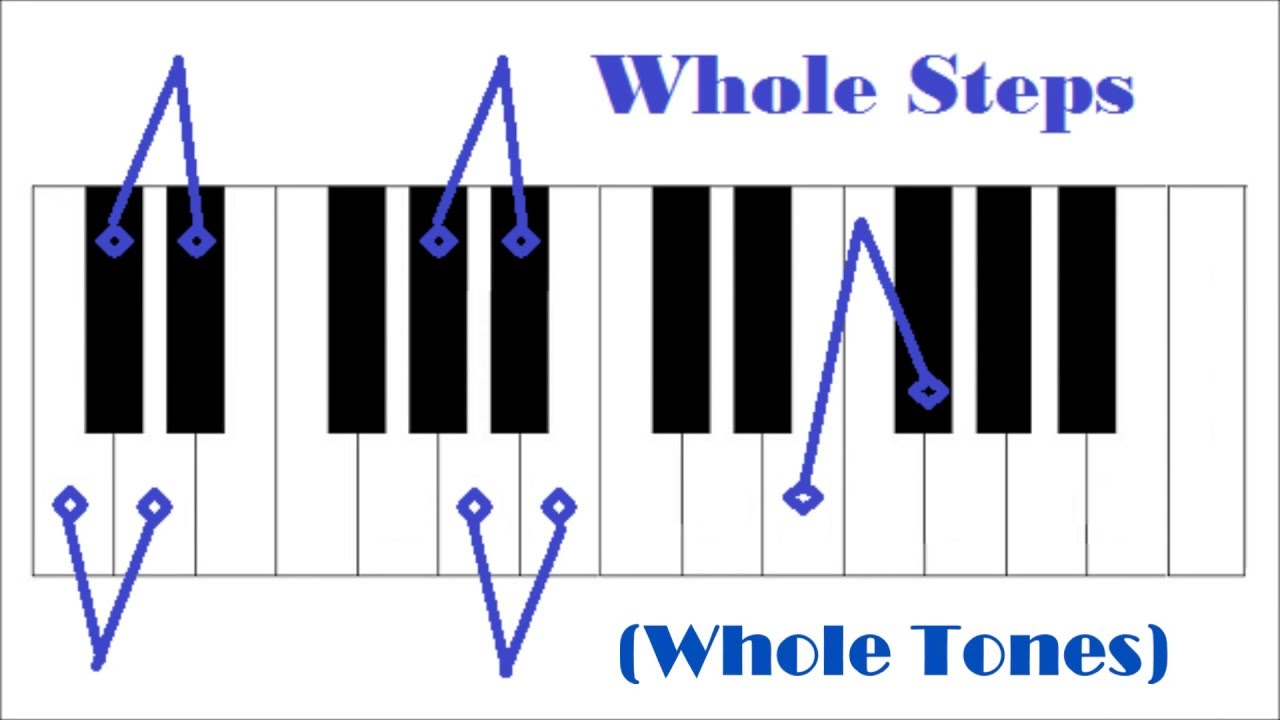
A whole step is just two half steps. You skip one key.
- C to D is a whole step (you hop over C#).
- F to G is a whole step (you hop over F#).
That's the entire vocabulary. Half step = next key over. Whole step = skip one. Everything below is built from these.
How Chords Are Built (One Simple System)
Here's the payoff. Once you can count half steps, you can build almost any chord on piano from any note. No memorizing a giant piano chord list. Just a little counting.
Every chord is a stack. You start on a note (the root), then hop up a set number of half steps to reach each next note. Change the hops, change the chord.
We'll count each hop from the note you just landed on. So "+4, +3" means: start on the root, hop up 4, then from there hop up 3 more.
Let's build all three basic chords on piano starting from one friendly note: C.
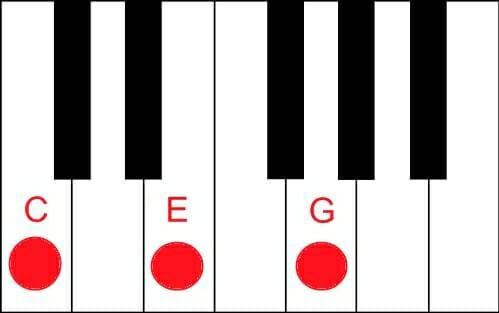
C Major
Bright and happy. Hop +4, +3.
C → up 4 → E → up 3 → G.
C major = C, E, G.
Play those three together with fingers 1-3-5 in your right hand. That clean, resolved, "everything's fine" sound? That's the most important chord in music.
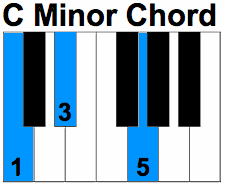
C Minor
Soft and sad. Hop +3, +4 (the same two numbers, just flipped).
C → up 3 → Eb → up 4 → G.
C minor = C, Eb, G.
Only one note moved. The middle note dropped a half step, from E to Eb. That single key is the entire difference between happy and heartbreak.
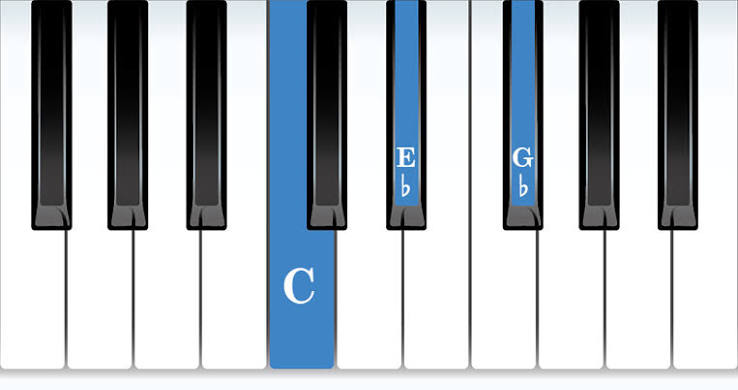
C Diminished
Tense and unstable. Hop +3, +3.
C → up 3 → Eb → up 3 → Gb.
C diminished = C, Eb, Gb.
Both hops are equal, which squeezes the chord tight and gives it that nervous, "something's about to happen" feeling. Used in small doses for drama.
(On a side note… ) Ready to actually play, not just practice?
If you're in LA and want to learn chords on piano the right way from the start, this is where a teacher earns their keep. Angeles Academy of Music offers piano lessons in Los Angeles at our Brentwood, Westwood Village, and Tarzana studios, for kids ages 5 and up and adults returning to music after years away. Warm teachers, real working musicians, quick wins. Book your first piano lesson or call (310)-803-9286.
Now Generalize: The Same Shapes Work in Every Key
Here's the part that saves you months.
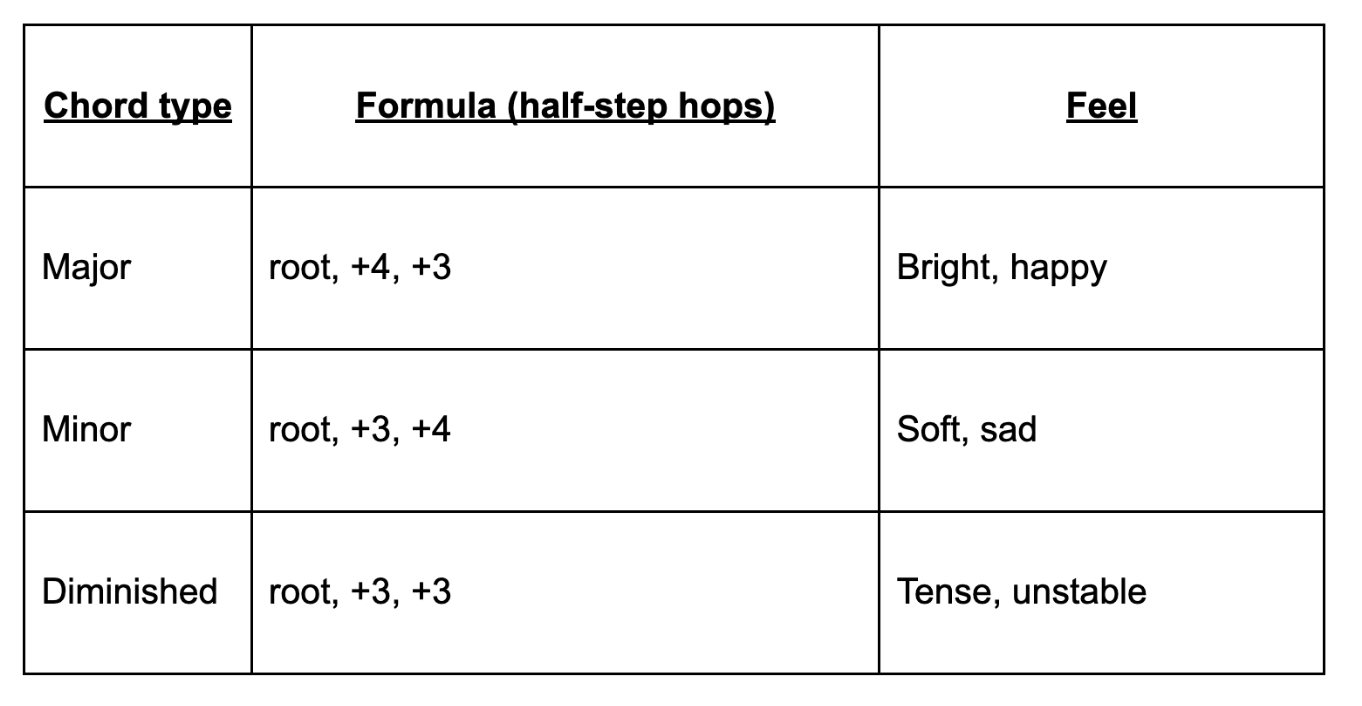
Those hop patterns don't care what note you start on. +4, +3 makes a major chord whether you begin on C, G, F, or that scary black key you've been avoiding. The formula is the key. The starting note is just where you plant it.
So the three formulas that unlock every major, minor, and diminished chord are:
Want G major? Start on G, hop +4 to B, hop +3 to D. G, B, D. Done.
Want D minor? Start on D, hop +3 to F, hop +4 to A. D, F, A. Done.
Want the dreaded C# chord on piano? Start on C#, hop +4 to F, hop +3 to G#. C#, F, G#. It's a black key, not a boss fight.
This is how all the chords on piano are built. Learn the three formulas, and you can play any major, minor, or diminished chord in any of the 12 keys. That's not an exaggeration. That's just counting.
Sit with those three for a week. Once they feel automatic, you're ready for the fun part: color.
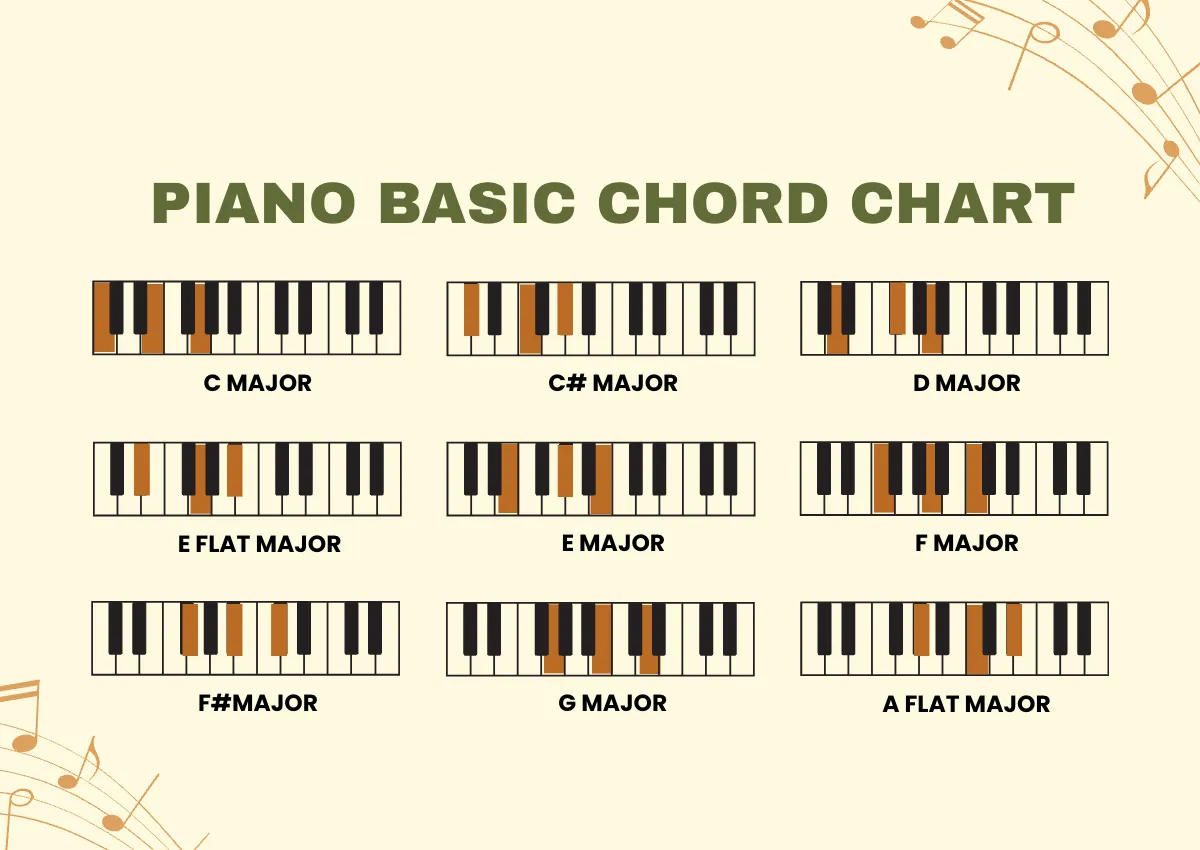
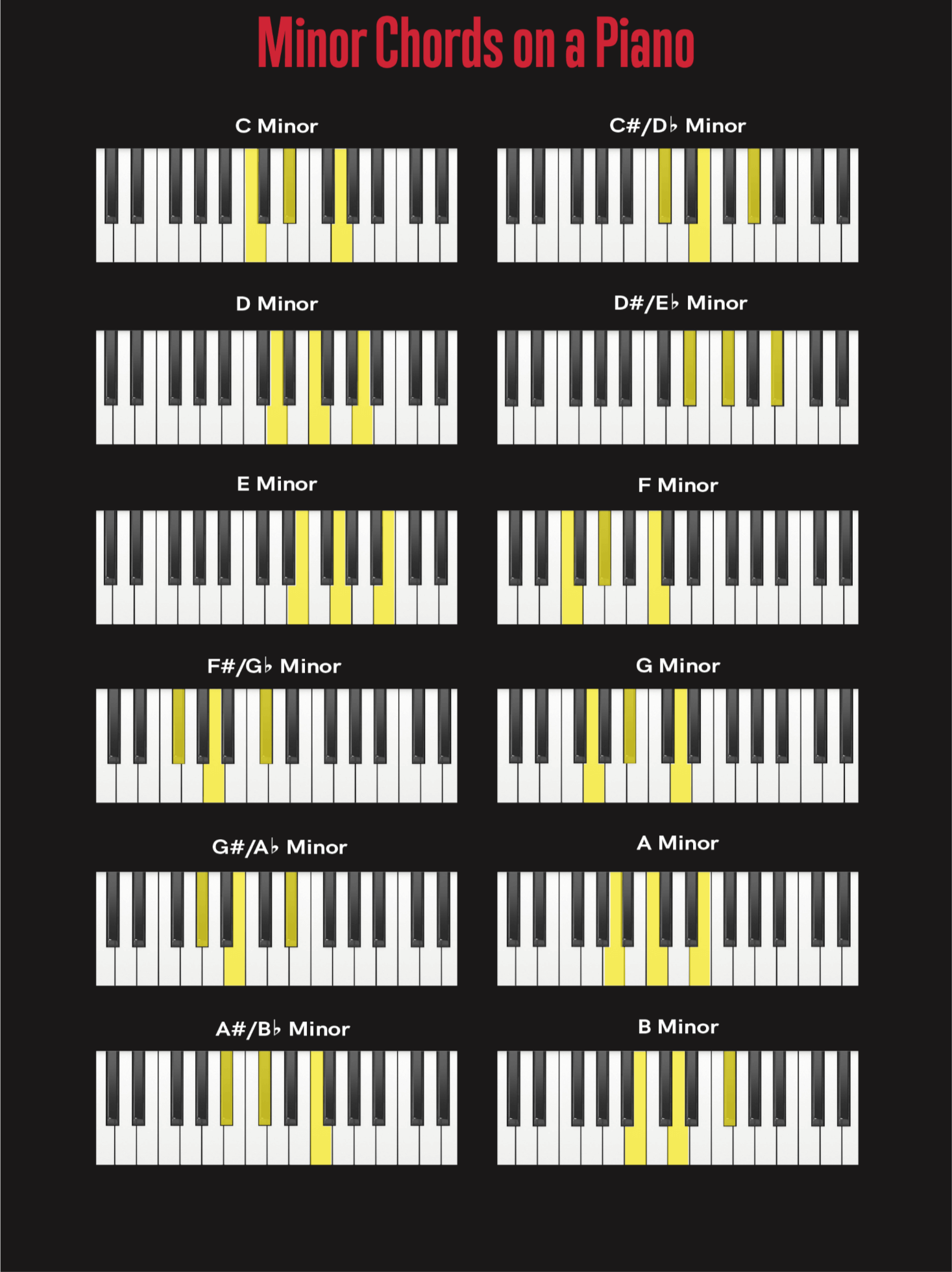
The Best Chords to Learn First (How to Learn Piano Chords Without Quitting)
Let's be real about how to learn piano chords.
Most beginners don't quit because piano is too hard. They quit because they try to learn all the chords on piano at once, get overwhelmed, and decide they're "just not musical."
You don't need all the chords. You need four.
Start here, in this order:
- C major (C, E, G)
- G major (G, B, D)
- A minor (A, C, E)
- F major (F, A, C)
That's it. Those four are the common piano chords behind more songs than you'd believe. Remember the four-chord progression from earlier? C, G, Am, F. You now have every chord in it.
Now put those chords to work. Once you can play C, G, Am, and F comfortably, you're ready to start using them in actual music. Our guide to easy piano songs for beginners is a good place to find simple songs you can practice with the chords you've just learned. Because knowing four chords is useful. Hearing them turn into an actual song is where piano starts getting addictive.
Here's your first-week plan. Ten minutes a day. Less time than you'll spend stuck on the 405.
- Day 1–2: Just C major. Press it, release it, press it again. Feel the shape.
- Day 3–4: Add G major. Practice switching C to G, slowly.
- Day 5–6: Add A minor and F major.
- Day 7: Loop all four. C, G, Am, F. Congratulations, you're playing a song.
Don't rush to add the fancy stuff. The different piano chords with all the colors and extensions will still be there next month. Speed comes from comfort, not cramming.
One tip from years of teaching in LA: practice piano keys chords with your eyes closed once you know the shape. Feeling the keys instead of staring at them is what separates people who "know chords" from people who actually play.
If you want to make those ten minutes count, the next step is having a practice routine you can actually stick with. Our piano practice guide for adults and teens breaks down how to build piano skills through focused, consistent practice without turning every session into a marathon.
Adding Color: 7ths and 9ths
The chords above are triads, three notes each. They're the foundation. But if you've ever wondered why a jazz tune or an R&B ballad sounds so much richer than a simple pop song, the answer is usually color chords.
Color chords are just triads with an extra note stacked on top. Same root, same base shape, one more layer of flavor. Here they are, still built on C.
Dominant 7th (written C7) — bluesy and restless. Build C major, then add one more note +3 above the top.
C, E, G, then up 3 from G → Bb. C7 = C, E, G, Bb.
This is the sound of blues, gospel, and any chord that feels like it's leaning forward, wanting to move somewhere.
Major 7th (written Cmaj7) — dreamy and warm. Build C major, then add one more note +4 above the top.
C, E, G, then up 4 from G → B. Cmaj7 = C, E, G, B.
Soft, floaty, romantic. The "sunset at a Santa Monica coffee shop" chord.
9th (written C9) — lush and full. Take C7, then keep stacking one more note +3 above that.
C, E, G, Bb, then up 3 from Bb → D. C9 = C, E, G, Bb, D.
This is where things get rich. Neo-soul, jazz, film scores. That "how did they make it sound so expensive" feeling? Often a 9th.
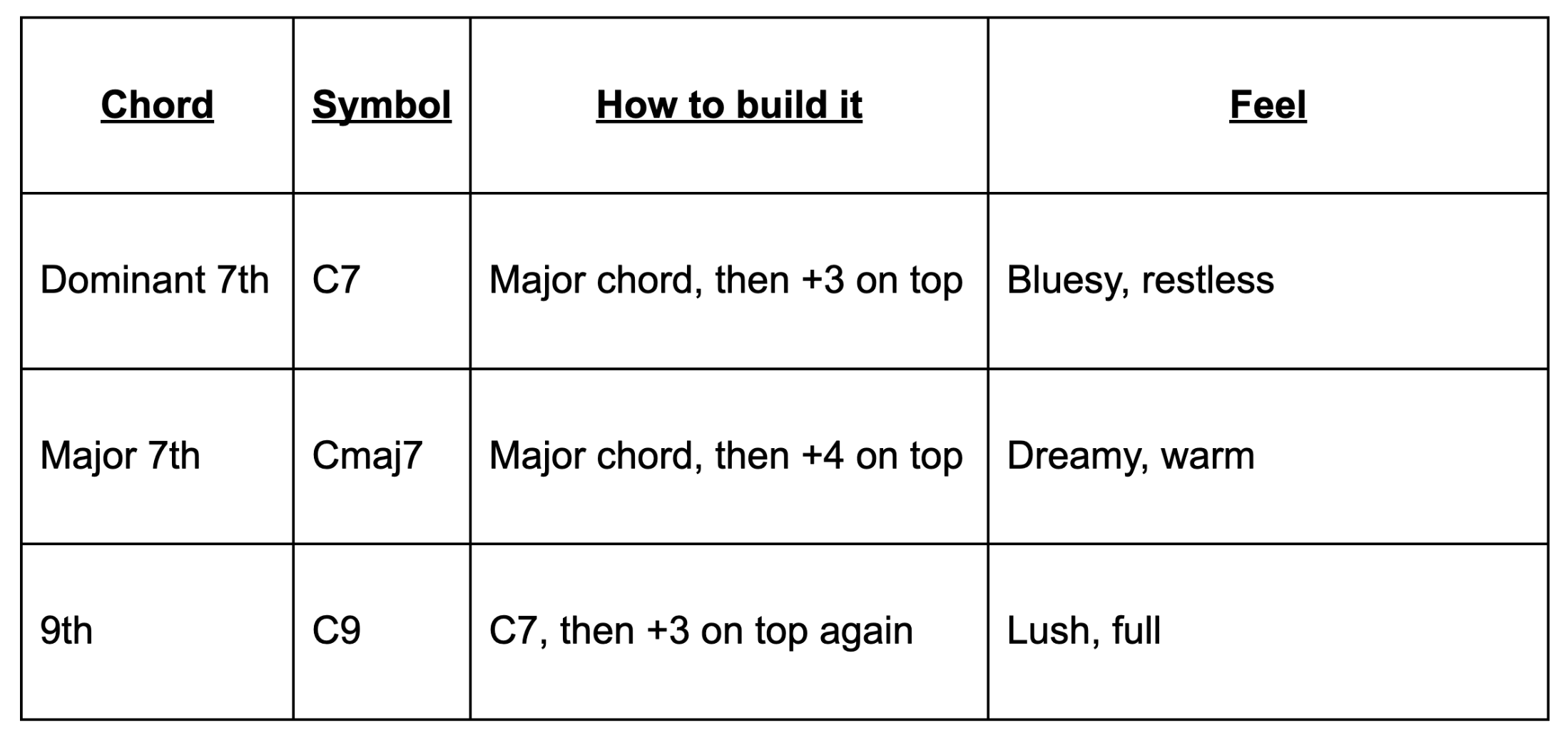
And just like the triads, these formulas travel. G7 is G major plus a +3 note on top. Fmaj7 is F major plus a +4 note on top. Same recipe, different starting note.
Here's the honest truth about how to learn piano chords: you don't grind through all of them at once. You learn the three triad shapes, get comfortable, then add color one flavor at a time. That's how every player you admire actually did it, one shape at a time, until it became second nature.
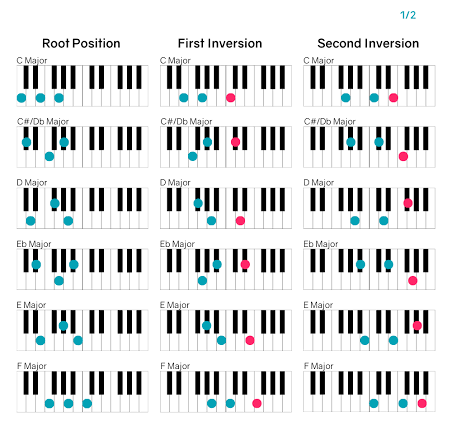
A piano chords chart can show you the finished shapes. But understanding how they're built is what lets you play without one. That's the difference between memorizing and knowing.
If you're helping a child learn, the same principle applies, but the practice routine needs to feel a little different. Short, focused sessions usually work better than forcing a child to sit at the piano for an hour. We have an artcile on how to make piano practice for for children. This has practical ideas for parents on making piano practice more consistent, productive, and, importantly, less of a daily battle.
Chord Inversions (Play Smoother, Move Less)
Once you can build chords, here's the next unlock. You don't always have to play them in the same boring order.
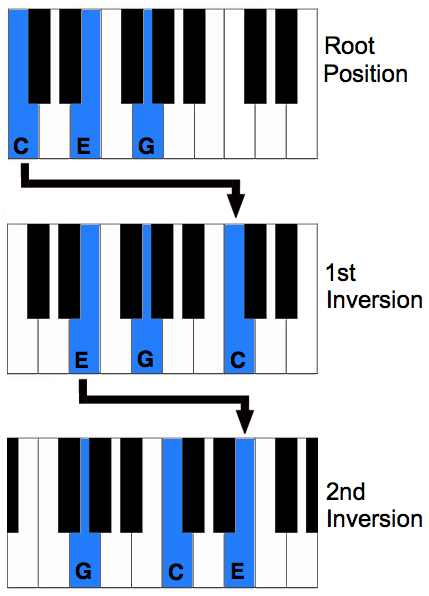
An inversion just means you rearrange the same notes.
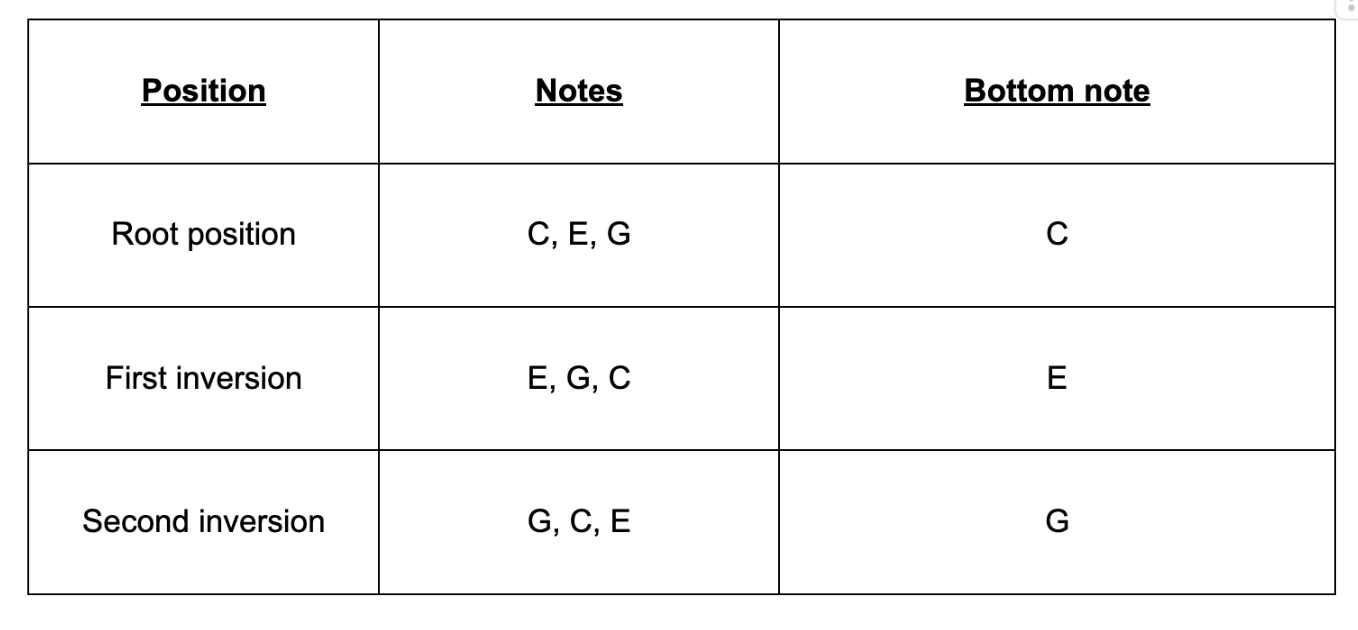
Take C major: C, E, G. That's called root position, because the root (C) is on the bottom.
Now move that bottom C up to the top. You get E, G, C. Same three notes, same chord, different shape. That's the first inversion.
Move the bottom note up again and you get G, C, E. That's the second inversion.
Three ways to play the exact same chord:
Common Mistakes Beginners Make with Chords on Piano
After teaching hundreds of students across Brentwood, Westwood, and Tarzana, I can tell you the mistakes are almost always the same five. Fix these early and you'll skip months of frustration.
1. Tense hands. New players death-grip the keys. Your hand should be relaxed, curved, like it's resting on a doorknob. Tension is the enemy of speed and the fastest route to sore wrists.
2. Ignoring fingering. People play chords with whatever fingers feel easy in the moment. Then they hit a chord change and everything falls apart. Learn the right fingers (1-3-5 for most triads) from day one. Your future self will thank you.
3. Staring at a chart forever. A piano chords chart is a map, not a destination. Use it to learn the shape, then look away. If you can only play a chord while reading it, you don't know it yet.
4. Skipping the "why." Memorizing shapes without understanding how to read piano chords or how they're built is like memorizing directions instead of learning the city. The second you hit an unfamiliar chord, you're lost. Learn the half-step formulas and you can figure out any chord on piano yourself.
5. Practicing without a plan. Noodling feels productive. It isn't. Ten focused minutes beats an hour of aimless pressing. Pick a goal each session, one chord change, one progression, and drill it.
Here's the honest part. A piano chords chart and a YouTube video can teach you the shapes. What they can't do is watch your hands, catch the tension in your wrist, and fix your fingering before it becomes a habit you spend a year unlearning.
So why bother? Two big reasons.
One: smoother movement. When you switch from one chord to the next, inversions let your hand barely move instead of leaping across the keyboard. Go from C major to G major in root position and your hand jumps. Use the right inversion and your fingers practically slide over. Less motion, fewer mistakes, better sound.
Two: different texture. The same chord feels slightly different depending on which note sits on top. It's a subtle way to change the mood without changing the chord.
You don't need to master inversions on day one. But the moment your chord changes start sounding clunky, inversions are the fix. This is one of those things a good teacher spots in about ten seconds, something a piano chords chart alone can't correct for you.
Chord Progressions (Where Chords Become Songs)
This is the big one. The moment piano clicks.
A single chord is nice. But songs aren't built on one chord. They're built on chord progressions, which is just chords played one after another in an order that feels good.
And here's the secret that'll blow your mind: most of the songs you love use the same handful of progressions.
Learn a few, and you can play thousands of songs. That's not hype. That's how pop music works.
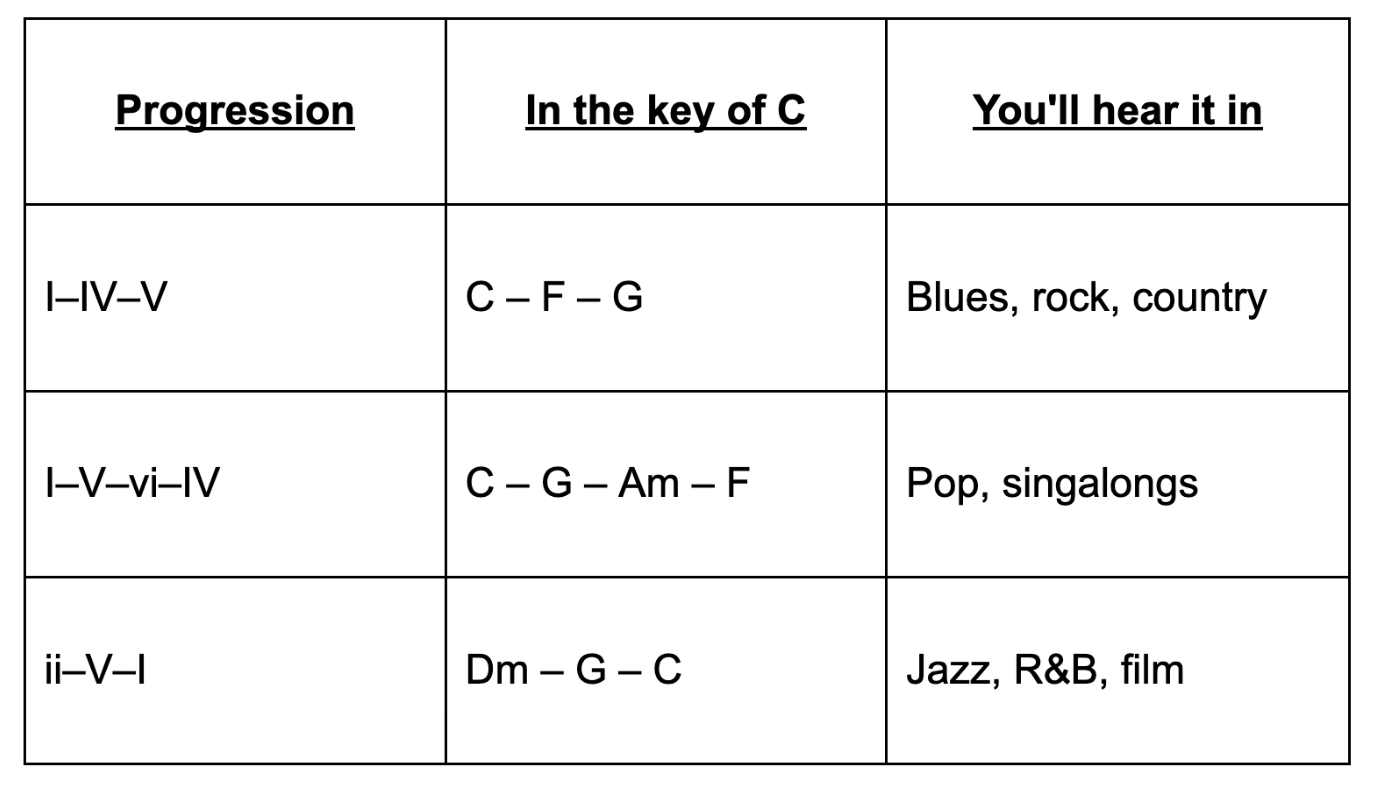
Let's cover the three that matter most. We'll write them in C so you can play along right now.
The I–IV–V (the backbone of everything)
Musicians number the chords in a key with Roman numerals. In the key of C, that's:
- I = C major
- IV = F major
- V = G major
Play C, then F, then G, then back to C. That progression is the foundation of blues, rock, country, and about a century of hits. Once your ear catches it, you'll hear it everywhere.
The I–V–vi–IV (the "four chord song")
This is the famous one. The progression behind a shocking number of pop hits. In C:
- I = C major
- V = G major
- vi = A minor
- IV = F major
Play C, G, Am, F on a loop. Seriously, just loop it. You will immediately recognize it, because it's the emotional engine behind countless singalongs. Four chords. Endless songs.
The ii–V–I (the jazz move)
Want that smooth, sophisticated sound? This is the jazz staple. In C:
- ii = D minor
- V = G major
- I = C major
Play Dm, G, C. It sounds like resolution, like a musical sentence landing perfectly. Add color chords (Dm7, G7, Cmaj7), and you've got the sound of a jazz trio in a dim Hollywood lounge.
Here's what to take away: song piano chords aren't random. They follow patterns. Learn the patterns, and you stop playing chords one at a time and start playing music.
Learning Piano Chords in Los Angeles: Why a Teacher Beats a Chart
Here's the thing about LA.
This is a city that runs on music. Kids grow up seeing shows at the Hollywood Bowl. There's a piano in half the coffee shops in Silver Lake. Someone is always playing something, somewhere, from Venice Beach to the Valley.
So when families start Googling piano lessons near me at 11pm, they're not chasing a hobby. They're chasing that feeling. The one where their kid sits down and plays something real.
And a piano chords chart can only take you so far toward it.
A chart shows you the shapes. It won't tell your seven-year-old why her wrist hurts. It won't catch the bad fingering that turns into a six-month habit. It won't keep an adult beginner motivated through week three, when the excitement fades and the actual work begins. That's what a teacher is for.
That's exactly what we do at Angeles Academy of Music.
We've been teaching piano classes in Los Angeles since 2013, with studios at our Brentwood music school, Westwood Village music school, and Tarzana music school. Our studios have real Yamaha and Kawai pianos, not toy keyboards, and our instructors are working musicians who actually gig around this city. But mostly, they're warm. That matters more than any credential when a nervous kid sits down for their first lesson.
Whether you're searching piano lessons Los Angeles, keyboard lessons near me, or just "piano teacher near me" while stuck in Westwood traffic, here's what makes families stay:
- All ages, all levels. Kids from age 5, teens, and adults returning after decades away.
- Three convenient LA locations. Brentwood, Westwood Village, and Tarzana, so there's likely one near you.
- Real pianos, real musicians. Not a side hustle. Not a chain. Actual teachers who love this.
- Warm, not intimidating. The vibe is welcoming first. High standards, zero pressure.
The families who travel from Beverly Hills, Santa Monica, Culver City, Encino, and across the San Fernando Valley aren't coming for a chart. They're coming for someone who sits beside their kid and says "try that again, but relax your hand." That's the difference between knowing about chords piano and actually playing them.
Piano Chords FAQ (What Chord Is This, and Other Questions Beginners Ask)
What is a piano chord?
A piano chord is three or more notes played at the same time. Two or more notes technically counts, but most real chords start with three (a triad). Chords create the harmony and mood of a song, while single notes carry the melody.
What are the most common piano chords?
The four most common piano chords for beginners are C major, G major, A minor, and F major. Learn those and you can play thousands of songs, because that C–G–Am–F progression is behind a huge share of popular music.
How many chords are there on piano?
Technically, a lot. Between all 12 keys, plus every chord type and inversion, the number of different piano chords runs into the hundreds. But you don't need them all. A working set of major, minor, and seventh chords covers nearly everything a beginner and intermediate player will touch.
What chord is this on piano?
To figure out what chord is this on piano, name the notes you're playing, then check the spacing. Root plus 4 then 3 half-steps is major. Root plus 3 then 4 is minor. Those two patterns identify most chords you'll run into. A chord-finder tool or a piano chords chart speeds it up.
Is the C# chord hard to play?
No. The C# chord on piano (C#, F, G#) uses black keys, which looks scarier than it is. It follows the exact same major formula as C major, just started one key higher. Black keys aren't harder, they're just off-center.
Should I learn chords or notes first?
For most people, chords. Learning chords on piano lets you play recognizable songs within weeks, which keeps motivation high. Note reading is worth learning too, but chords give you the early wins that stop people from quitting.
How do I learn piano chords fast?
Start with four chords, practice ten focused minutes a day, and use the half-step formulas so you understand what you're playing instead of just memorizing shapes. Consistency beats marathon sessions. And a teacher who catches your mistakes early makes how to learn piano chords dramatically faster.
How much are piano lessons in Los Angeles?
At Angeles Academy of Music, weekly 30-minute private lessons start around $192–$218 per month depending on location. New students currently get 50% off their first four lessons. That covers real one-on-one instruction, not group drop-ins.
Where can I take piano lessons near me in LA?
Angeles Academy of Music has three studios: Brentwood, Westwood Village, and Tarzana, serving West LA, Beverly Hills, Century City, Santa Monica, Culver City, and the San Fernando Valley. Call (310)-803-9286 or request info to book.
Start Playing (Your First Chord Is Closer Than You Think)
Here's the truth this whole guide comes down to.
Piano chords are the fastest path from "I've always wanted to play" to actually playing. Not years of sheet music. Not a music degree. Just a handful of shapes, a little half-step counting, and ten minutes a day.
Learn C, G, Am, and F. Loop them. You're playing a song by the end of the week.
The piano chords chart in this guide will get you the shapes. The formulas will let you build any chord you want. And when you're ready to stop guessing and start really playing, a good teacher will get you there faster than any video ever could.
If you're in LA, that door is open.
Whether you're a parent whose kid is ready for their first lesson, or an adult who's been meaning to do this for a decade, Angeles Academy of Music is here in Brentwood, Westwood, and Tarzana, ready to help you play. Warm teachers. Real pianos. Quick wins.
Your first chord is closer than you think.
Start Your Piano Lessons Now.
.svg)



.svg)

